Saturday, March 26, 2011

Indian Runners


Spring is in the air and that means lots of baby animals.  Yesterday we picked up our order of 5 Indian Runner ducklings (4 females, 1 male).  They are so cute.  If you are wondering what the colored spots are on their heads, the hatchery from which they came paints the heads of the females with a red dot and males with blue. 


Indian Runner ducks are land ducks that do not need a pond, just a small pool or tub of water to occasionally bath in.  They lay from 150-200 eggs a year or more.  Indian Runners love foraging and running around grassy meadows looking for worms, slugs, even catching flies.  So far we have been observing them eating, jumping alot, and bathing in their drinking water. We are happy to have these new fuzzy friends. 


New Man In Town
About a month ago we adopted a Leghorn rooster from Sienna Ranch.  He is mild mannered but a little skittish.  It is said that a white rooster brings many blessings to a property and so we named him Barak, which means blessing in Arabic.  Our 7 year old agrees, "He is president of the chickens!"


Monday, March 21, 2011

Thoughts On Today

Today, like every other day, we wake up empty and frightened.
Don't open the door to the study and begin reading.
Take down a musical instrument.
Let the beauty we love be what we do.
There are hundreds of ways to kneel and kiss the ground.
Rumi


remembering the struggles of our ancestors,
times have been hard before
 
In these times where there is so much turbulance, change, and sorrow, we need to be desperately seeking out the joy and beauty that is all around us.  I have not written for awhile, feeling to overwhelmed by current events to talk about the new chicken tractor, the felted soaps, or the seedlings in the ground.  The mundane seems so trivial and yet it is what keeps us going day to day as we are cleansed by the rain and watch the shoots push up and grow tall, painting the hills green.  Meditating on what might be good information to share right about now I realized that many are feeling a bit helpless not knowing how to be proactive or what to do to protect ourselves-to feel empowered. Here is some knowlegde I have accumulated from various sources I trust on moving through trying times with wisdom and grace.  Protecting our bodies is just the first step but an important one we cannot afford to overlook! 

Radiation Concerns
It is fun and easy to incorperate these delicious foods into our diet.  Wake up people and take good care of yourselves.  The time is now. 


Native Californians have been harvesting seaweed as a main
 food in their diet for thousands of years

Foods and herbs recommended as offering the best protection against radiation:
sea vegetables (seaweeds)
fermented vegetables (especially cabbages and other brassicas)
dark green leafy vegis (collards, kale, mustards)
miso
daikon
burdock
mushrooms (reishi, shiitake)
lentils
coconut milk
black and green teas
anything high in Vitamin C
apple pectin
nettles
eleuthero (siberian ginseng)
cilantro


Notes on Eleuthero (Siberian Ginseng): 
Eleuthero is an adaptogen which reduces stress on the body by combating harmful toxins. Eleuthero has shown a protective effect in animal studies against chemicals such as ethanol, sodium barbital, tetanus toxoid, and chemotherapeutic agents.
eleuthero leaves and berries
 Eleuthero also reduces the side effects of radiation exposure. In animal and in vitro studies, Eleuthero has demonstrated effects of radiation protection (Yonezawa et al., 1989) and stress reduction (Takasugi et al., 1985). After the 1986 Chernobyl nuclear disaster, many Russian and Ukrainian citizens were given Eleuthero to counteract the effects of radiation. Eleuthero was also commonly used in Russia in oncology hospital departments to increase the tolerance of the patients to the adverse effects of chemotherapy and radiation therapy (Gvamichava, 1966; Khatiashvili, 1964, 1966; Kupin, 1986a, 1986b).
 

eleuthero root


Important Links to Check out with Lots More Info, Articles, and Recipes!!!


*This is intended to be an open forum.  Please respond with suggestions, comments, questions.  Let's educate each other, we are all in this together.
Happy Spring!

Tuesday, February 22, 2011

Goats, Sprouts, Roots, and Shoots

“All the World's Problems Can Be Solved in a Garden” 
 -Geoff Lawton


I realized I have not said much about our goats lately, probably not since the trauma with Poppy and her leg back in December.  Well, the report is that in the end the break healed well, not so well at first, but with some time and attention she is pretty much her old self again, jumping, butting, and playing with the others.  Poppy responded amazingly to her constitutional homeopathic remedy that was the cataylst for her healing. 

goat and chicken feed combinations stored in 5 gallon food grade buckets

All of the herd is growing rapidly and seem to always be ravenous.  We are finally getting organized with our feed storage and regimen, sprouting their grain, a combinaion of oats, barley, and black sunflower seeds.  (You can see the goat page for our full routine.)

soaked and sprouting goat feed

Fencing has also been a big priortity around here.  So after much waiting, gathering of materials, and a few weekends of work, the approximate 1/2 acre of pasture for the goats to graze is almost completely fenced in. 


Rosemary and Poppy grazing


Poppy getting a hug

Lots of sprouting going on around here these days.  A natural born seed saver, we have a 7 yr old who is obsessed with sprouting everything he can get his hands on from any and all sproutable goods in the pantry to the seeds inside the dinner vegetables.  There is a constant collection of wet napkins full of seeds on the windowsill. 

poppy sprouts on the windowsill
Spring Cleansing
Thinking about spring cleansing, root tonics, and simple home remedies, this recipe for Fire Cider is as easy as it is full of benefit.  Some healing properties of the roots are...

Horseradish:  anti-bacterial, horseradish strongly stimulates the digestion, increasing gastric secretions and appetite.  Also a good diuretic that promotes perspiration, useful in fevers, colds, and flu.  An expectorant and can be of use in respiratory and urinary tract infections. 

Ginger:  valued for it's ability to warm the stomach, to ease vomiting and nausea, and fight off colds, chills, and coughs.  Useful for all types of congestion in the body. 

Garlic:  supports immune function and opens the pores of the skin to lower a fever.  Anti-bacterial and antimicrobial properties make it useful in treating bladder and kidney infections, yeast infections, strep throats, and ear infections. 

Cayenne:  useful for increasing circulation and to get mucous flowing.  Anti-inflammatory and anti-irritant.  Used as a digestive aid to to stimulate gastric juices.  Can be used to gain relief from migraines. 

Fire Cider
Ingredients
1 quart organic apple cider vinegar
1/2 cup horseradish root grated
1/8 cup garlic chopped
1/2 cup onion chopped
1/2 cup ginger grated
1 tsp cayanne


Directions:  Place all ingredients in a large, clean, glass jar and cover with apple cider vinegar.  Cover tightly and steep for 8 weeks, preferably on a sunny windowsill.  Strain into clean jar. 


Make this soon so it will be ready for spring colds and sniffles.  (Try diluted in H2O first, it is very spicy!)

Wednesday, February 16, 2011

Beautiful Bounty

fresh eggs looking like candy
Egg update:  The younger group of our chickens have been laying for a couple of months now.  I am amazed daily at the beautiful colors of the shells.  The Wellsummers' eggs which I expected to be a chocolate brown are more like a deep cinnamon color, I love it.  In about a week or so we plan to add some Maran chicks to our flock.  Our ladies really love the addition of the flax to their diet, as well as the handful here and there of the black sunflower seeds we bought for the goats.  Happy chickens indeed. 


We are definitely learning about the infinate ways to prepare an egg.  Frittata again for dinner tonight?

Mini Green House


So I sing to my seeds. 
What about it?
- Leslie Gaydos


seed starters waiting to go in the greenhouse

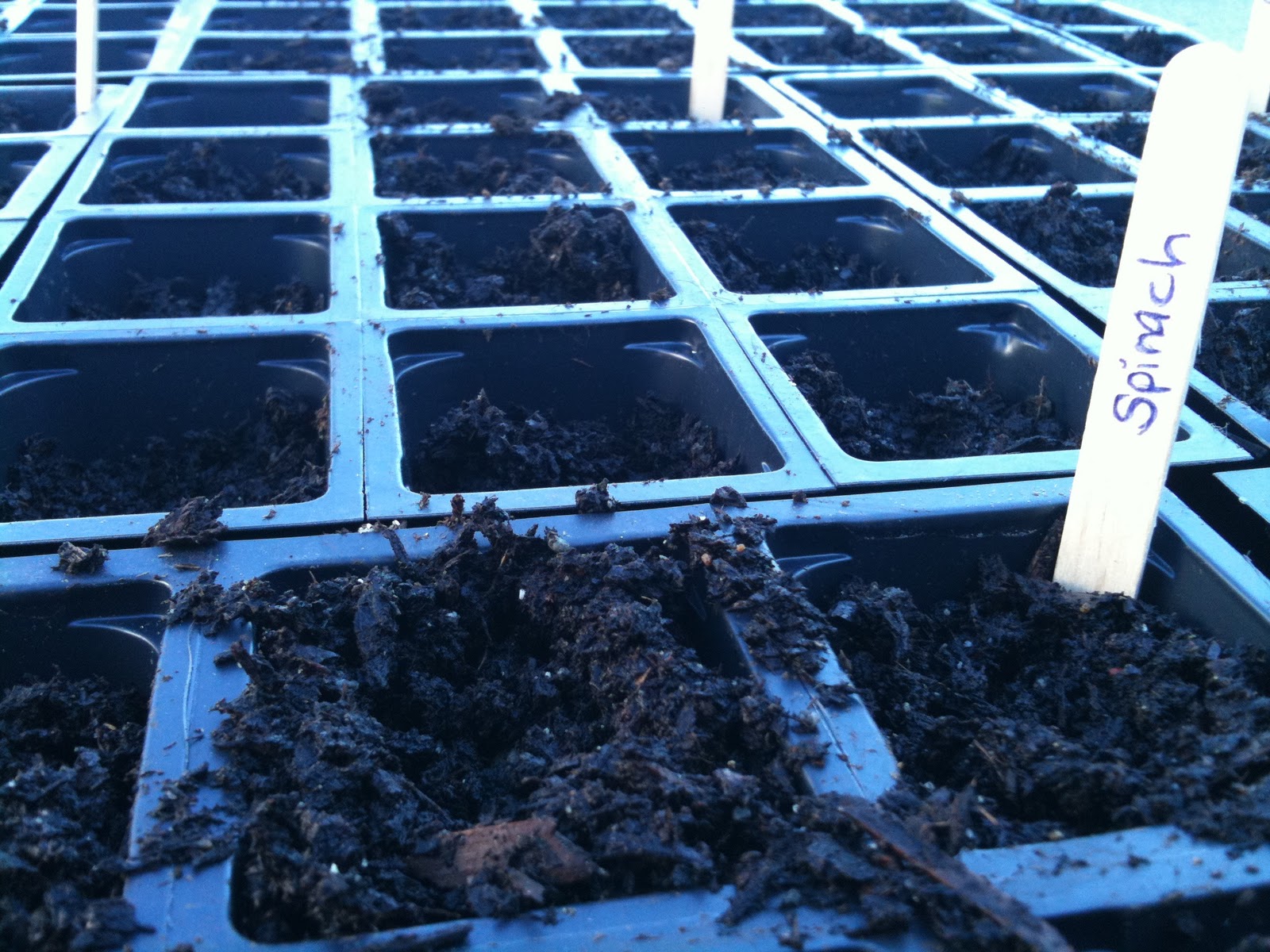
It's been nice to get a jump sart on the growing season.  We've started planting our seed starters to transplant in the spring.  Baby and giant spinich, rainbow chard, different varieties of kale, broccoli, collards, pumpkins, melons, zucchini, lettuce, fennel, borage, and more.  The potatoes and garlic are in the ground and the mini green house is pretty much complete, just needs a few finishing touches.  

tiny lettuce seeds

The mini green house is 5'x 20' and made to fit over a rectangular garden bed.  Small, light weight, and sturdy, each side of the top lifts and can be propped up by a pole.  A fairly simple design, we made this one completely from found and free materials, mostly used wooden pallets and plexiglass from craigslist. 


Here is the almost finished product which has held up to slamming winds and rain the last few days and it stays pretty warm in there. 
You can find the plans for this greenhouse in The Backyard Homestead Mini Farm Guidebook, by John Jeavons. 


Wednesday, February 9, 2011

Many Uses of Stinging Nettles


Technically it is still winter but spring is filling the air and that always means one thing to me...almost time to harvest stinging nettles.  It may still be a little early but this warm spell has got me itching to get out to the woods.  When I was in herb school this is one plant I got to know very well.  After drinking a quart of nettle tea every night for 2 weeks, I watched my skin and hair glow and my energy sore.  Nettles is definitely a healing plant so if you don't know about it, learn more and if you just forgot, now is the time to use your green allies for spring cleansing and rejuvination! 
I just recieved a wonderful recipe from a friend that has been passed down for generations from her grandfather in Germany.  I can not wait to try it out.  (Thanks Anna!)

Stinging Nettle Liquid Manure
Stinging nettle liquid manure has balancing and healing properties, stimulates growth and chlorophyl production. Worms love soil that is fertilized with this manure.

-Use the whole fresh plant cut in pieces. (possible to use dry plants as well) 
-Prepare a plastic, ceramic, or wooden pot or barrel (no metal pots).  Put in as many plants as you have.  Add enough water so that the plants are covered (best if you have rain water or use water that has been standing for a couple of days in the sun), cover with a piece of chicken wire to avoid small animals from falling in.  Don't fill the pot to the top because the liquid will foam during the fermentation process. Let the pot stand in the sun for about 2 weeks. Stir at least once a day. 

-A smell will develop and might offend your nose, so don't keep it too close to the house.

-The process has finished when the liquid has a dark color and doesn't foam anymore. Now you can cover the barrel with a lid. Dilute the liquid 1:10 or if you have used a small pot with a lot of nettle plants, 1:20 and water your garden with it.

-Other herbs to try: Symphytum/ Comfrey - lots of protein, the liquid manure is rich in nitrogen and potasium, good as tomato fertilizer (Symphatum can be combined with stinging nettle to make the manure)

-You can use all sorts of herbs combined: chamomile, mint, majoram...... try experimenting! You can also add some manure from chickens or cows (without the straw) or ripe compost.

-Use the liquid manure on your compost - that is the safest way. Otherwise make sure that you dilute it enough and don't spray over plant leaves but water the soil.

There are so many uses for this extraordinary plant. 
(Feral Kevin has an inspiring clip on juicing fresh nettles, www.feralkevin.com.)

You can try making nettle soup...


or nettle quiche...


If you are not familiar with this plant, get more ideas and learn how to harvest by clicking here, http://www.youtube.com/watch?v=D9ZdKdhKfcw

Happy foraging!

Friday, February 4, 2011

Sheet Mulching Part 2


 The beds we started preparing January 1st are now almost finished.  We finally got most of the manure in our driveway down the hill and spread out over sheet mulched beds.  It is pretty exciting.  Since there are so many eucalyptus trees here and we like to use what we have, the plan is to edge the beds with thick eucalyptus branches to give the garden a more finished look and to keep the beds from shifing too easily.  Also, still need to add a layer of compost over the top before planting.  It was hard to get a picture of the full design but from overhead the garden beds are two concentric circles with pathways cutting through.