Tuesday, October 30, 2012

The Meat Chickens


We are pleasantly surprised with our broilers who are now about six weeks old.  All the talk of how freakish the Cornish X are does not really seem to hold true.  Yes, they are ravenous at times and will eat, eat, eat continuously.  And yes, they will plop themselves down in front of the food to just sit, or really lie and eat.  But they are far from the frankenbirds we heard and read about.
They have definitely grown at an alarming rate and are now approximately three times the size of the layer chicks of the same age. And they do start out looking a bit different but once fully feathered they have grown to be pretty normal looking.  Otherwise,  the Cornish X seem to behave just like all the rest of our chickens, exploring and foraging around for food and enjoying dust baths in the sun.  Since we transferred them to the run (which is left open all day to give the flock access to the hillside) the meat chickens are free ranging with the rest of the birds.  There has not been much bullying by the layers either.


We have picked up a couple of tips to give them a better start and to help keep them healthy as they grow.  While they were still in the brooder we started adding apple cider vinegar to their water.  Their energy immediately increased and their stool went from watery yellow to normal looking chicken droppings.  Second, we tried to give them a variety of foods.  In addition to their chick starter we offered them mashed boiled eggs, greens, seaweed, kitchen scraps, and bits of grass.  At first they were only interested in the starter but after a few days they began eating all the different foods including pumpkin, which appears to be a favorite.  Fermenting the feed by soaking overnight and letting sit for a day or so is another tip we are eager to try out soon.


Sunshine Chicken is a website we stumbled across about free ranging, holistically raised meat chickens in the Philippines.  It is loaded with amazing information, videos, and great ideas for fermented supplements and super foods (for livestock) that are easy to make.


It has been interesting so far to learn about the Cornish X birds.  We have been discussing that it would be fun to try out some Freedom Rangers in the spring when the grass is high and there is more wild food to eat. We are also hoping to keep a couple of roosters and some hens to try breeding our own meat stock, therefore avoiding having to order from the hatcheries.  There is no doubt that raising our own meat birds is NOT cheaper than buying from the stores but there is satisfaction in knowing that they grew here from start to finish and that we had our hands in the process them.  (Not to mention that we are on a mission around here to find more sustainable -aka free- ways to feed these animals of ours.)

Friday, October 12, 2012

Slowing Down

Walk as if you are kissing the earth with your feet."
-Thich Nhat Hanh


How did life become so overwhelmingly busy?  With the start of the school year, time seems to have sped up and now, moving through October, it feels as if I am caught in an unseen whirlwind that has no allowance for a moment's rest.  I think everyone is feeling it.  So many people are under pressure, the same rush and push. However resistance is not futile, and I refuse to succumb to the grind.  Life is too beautiful and in slowing down, even just for a moment, we can see and appreciate the Gift of it all.  


Autumn is here, my favorite month, time to begin turning inward for reflection.  It is in the small things (like preserving a basket of apples from our tree) that I am forced to inhale, exhale, ponder, give thanks. Here and there in between the hustle bustle, we are like little squirrels, adding to our winter stores, one jar at a time.  
  

After a summer of canning, I have rediscovered the dehydrator with all of it's ease and now we are drying fruit and vegis in small batches when we have time, or when we think of it.  (There is one munchkin in the house who is devouring apple chips before they make it off the sheet.)

And in the spirit of not wasting, we started some vinegar today.  Good old apple peels and cores, filtered water, a few spoons of organic sugar, and a spoonful of yeast.  We'll wait a month or two and see what it becomes.  


My words to myself this week are to "reclaim my life".  It goes by too fast to not enjoy every precious minute.  Many blessings.-


Wednesday, October 10, 2012

Wondrous Elderberry

Don't ever take more from a plant than you need,
they enjoy having life as much as we do."
-Gypsy Wisdom


In preparation for our  recent herbal medicine making class, we went out on a few treks around our neighborhood to see what plants we could use for our concoctions.  The discovery of several prolific elder trees was a marvelous surprise.  The timing was perfect as they were laden with fruit.    Just in time for the coming winter, we  harvested baskets and bags of the ripe berries.  Our native elder tree here in California is Sambucus Mexicana.  We usually spot this tree along creeks, but not always.  One of the trees we just harvested from is on a hillside high above a creek, among a grove of Bay trees.  

fresh ripe elderberries
dried elderberries
There are so many interesting ways you can extract the medicinal constituents from sister elder's fruit.  Many people like to make syrups, wine, or dry the berries for later use in teas.  In some cultures elderberries are fermented into special drinks or porridge. I know a friend who likes to add handfuls of elderberries to her kombucha batches which gives the fermented drink a lovely color and taste. My preferred method of making herbal medicine is to make a glycerin tincture, and elderberries makes a glycerite that is effective, palatable, and strikingly beautiful.

Due to it's strong anti-oxidant properties, elderberry is known most widely as an immune booster.  It helps protect against colds and flu and acts as an anti-bacterial and anti-viral in the body. Elderberry is also useful in aiding the respiratory system, coughs, and tonsillitis. It is high in calcium, vitamin C and amino acids.


To make a fresh plant glycerite, harvest some elderberries.  Wash and take the time to remove as much of the stem as possible.


Put the berries into a clean glass container leaving a couple of inches head space   Mash the berries well then add sufficient food grade vegetable glycerin to cover the herb.  Stir to release air bubbles and add more glycerin as needed to fully cover herb.  Agitate 2x daily for  a minimum of 14 days.  (The longer you let it sit the better.)  Strain well, press, and store in glass jars.  More glycerin can be added after pressing and straining to improve preservation.  The shelf life will be 1-3 years.  


Check out this video by Mountain Rose Herbs on how to make elderberry syrup.  If you have never made an herbal syrup you will be pleasantly surprised at how simple it is.  Enjoy and happy autumn!


Saturday, October 6, 2012

Intensive 6 Day Permaculture Seminar & Workshop


We are so fortunate to be able to host this amazing event!  Our friend, Rhamis Kent, has been traveling internationally, teaching and studying with world renowned permaculture design expert Geoff Lawton.  Now those of us in the Bay Area can benefit from Rhamis's wealth of knowledge in this information packed, hands on course. Check out details below and register HERE!
Email us at soulflowerfarm@gmail.com for more information.
Over 6 days you will acquire the practical skills to regenerate any landscape and to design productive ecosystems.
In this 6 day course you will learn:
  • Basics of Permaculture Design
  • Soil Biology
  • Specialized Compost & Worm Farm
  • Water Harvesting Strategies
  • Grey Water Treatment
  • Drought Proofing
  • Designing & Implementing a Food Forest
  • Designing Micro Climates
  • Integrated Animal Systems
  • Basics in Aquaculture & Aquaponics
  • Permablitz
Course Content

Each session is 1 hour 30 minutes.
Day 1

First Session
Making the case for Permaculture/Agro-Ecology

Second Session
Ethics, History of Permaculture, Working Examples

Third Session
Concepts and Themes in Design for Productive Eco-systems

Fourth Session
Designing for Sustainable Communities

Day 2

First Session
Soil Biology Primer & Principles

Second Session
Plants & Soil: symbiotic relationships

Third & Fourth Sessions
Practical: making Specialized Compost, Natural Mineralisation and Worm Farm

Day 3

First Session
Water Principles & Harvesting

Second Session
Earthworks, Designing Water Harvesting Strategies

Third Session
Keyline Design and Grey Water

Fourth Session
Practical: Miniature Earthworks exercise

Day 4

First Session
Climate and Micro-climate

Second Session
Designing Micro-climates

Third Session
Aquaculture

Fourth Session
Aquaponics

Day 5

First Session
Theory and History of Food Forests
Symbiotic Relationships between Productive and Support Species

Second Session
Designing a Food Forest for Dry Climates
Integrated Pest and Disease Management

Third Session
Integration of Animal Systems
Sample Designs for Maximising Plant Spacing and Symbiotic Relationships
Drought-proofing and Fire-proofing

Fourth Session
Practical: Seed Scarification and Tree Planting

Day 6

First Session
Design, Methods and Tools

Second & Third Sessions
Guided Design Exercise through Observation and Analysis

Fourth Session
Where to from now, Questions and Answers


Friday, September 14, 2012

A New Adventure in Self Sufficiency


Our chick order arrived today.  Twenty five Cornish meat chicks plus several layer breeds that had just come in with our order.  About half of our layers are getting old and their egg production has been decreasing.  We are thinking some of them will need to be replaced in the spring.  I bought some Rhode Island Reds, Ameraucanas, and Black Australorps because I like those breeds, they are efficient layers and good sized birds.


The chicks were super sleepy from the rough journey but are now happy in their new home.  My carpentry skills are slowly improving.  
I seem to solely focus on building cubes for animal homes, but each cube gets better.  This one is quite large so the chicks can stay in here comfortably for a month or so until they go outside into their run.


Raising our own meat chickens will be an adventure for us but I, for one, am ready.  Every time I purchase a whole chicken for our boys I cringe and think how much better it would be to raise them ourselves. Well, we will see how it goes...so much of what we are doing is a big experiment.  I definitely don't think it will be any cheaper but the peace of mind we'll have knowing we will pasture these birds and harvest them with our own hands may be worth it.  For now they sure are the cutest little fuzz balls.  It's been awhile since we have had chicks around here.  Next may just be wild turkey jerky...


Monday, September 10, 2012

September: Working Together

Three things cannot be long hidden: the sun, the moon, and the truth.  -Buddha


With the start of the school year, getting organized, and home school planning, many of the items on the farm to-do list have been either postponed or neglected.  This past weekend was the perfect time for us to host another community work party.  The feeling of so much productivity and being able to check almost everything off our list was extremely satisfying.  Our group has been wonderful, helpful, supportive, and super hard working!   

   Before the work party we harvested a lot of the
squash to make room for new seedlings.


As our co-op has evolved, all the participating house holds have learned that so many hands working together can go through way more tasks than anticipated.  Hence, the ambitious to-do list below. We accomplished almost everything, and we are especially grateful that all the hard jobs are done!  Like moving the huge truckloads of manure and mulch all over the property.  


We all broke up into groups and one crew had the sweet job of picking all the ripe tomatoes.  Maybe not so sweet, since we have had no time to keep up the tomato patch and it was completely overgrown with the cages falling over (a favorite hideout spot for renegade chickens who want to hatch their eggs).


The harvest was made up of such beautiful colors...soon to become sauce and salsa.  


The crew who moved most of the manure had the hardest job.  (We didn't get any pictures of their sweaty faces because we were too busy being sweaty ourselves.)  Our hugelkulture bed in the front garden now only needs a layer of soil/compost before we can plant.  We are thinking of planting a mixture of lettuce and more purple tree collards--you can NEVER have too many of those, by the way.  


And some new semi-sheet mulched beds in the backyard kitchen garden are now filled and waiting for rain to compost them down.  


Oh, and we can't forget some of the best helpers of all- the children! They did a superb job of shelling favas for fall cover crops and painting garden signs.  


Some friends stayed for the after party and added a much needed new layer of cob to our oven.  After weathering the last winter without a roof, it needed some attention.  We added something new to the bottom, the arabic word Haq,(حق) meaning Truth.  

An end of the day trade looking gorgeous in the basket, staples of farm fresh bread, milk, and eggs.  We must never forget how truly blessed we all are.  Thank you to all who came to help and who added their special touch to our farm.  Much Love!


Tuesday, August 28, 2012

DIY Cider Press

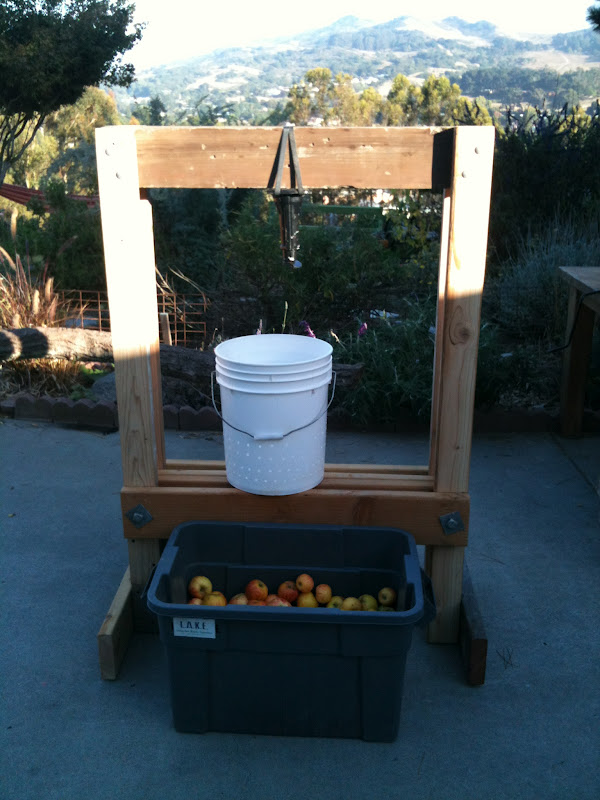
Summer is almost over and the rain of Gravensteins has come to an end.  The shelves are stocked with quarts of apple sauce for winter. This year we really wanted to try our hand at pressing some of the remaining fruit into sweet cidery goodness.  So the crafty men of the house came up with this cider press which I think is quite impressive.  


Some scrap wood, bolts, screws, a car jack, a bar for the crank, a spare five gallon bucket, and an old cookie sheet make up the materials for the press.  The apples need to be crushed before they get pressed, we used a mallet covered with a plastic bag.  The process works best if the bucket is full of crushed apples when you start.


A heavy block of wood and a tree round cut and put through the planer to make them smooth are the main pressing agents.  


The crank forces the blocks of wood to tighten down around the crushed apples which pushes the cider through the drilled holes in the bucket.  

For the first few gallons of cider we just poured the juice off of the cookie sheet into jars but have now found a round stainless steel plate with a lip into which we will drill a hole so the juice can run down into a jar below the press.  The bucket worked surprisingly well and there was very little pulp in the juice.  


We have been enjoying this last bit of summer sweetness every morning in our smoothies and in the evening warmed with spices.  It doesn't seem like we will have much for the freezer the way the kids have been guzzling it down.  The taste of fresh pressed cider is one of the seasonal experiences a happy childhood is made of.