Tuesday, July 31, 2012

Colors of Summer

Every great dream begins with a dreamer.  
Always remember, you have within you the strength, 
the patience, and the passion to reach
 for the  stars to change the world    
~ Harriet Tubman 


These summer days have been long, rising early and heading outside for chores can feel less than desirable.  But the early morning hours are so preciously quiet, filled with bird songs, cool air, a vast sky, and the slight touch of dew.  There is so much to be done in a day.  Waking before the sun makes the day longer, a secret farm women (and men) must have known forever.


As the day is slowly beginning to unfold, I pause to appreciate some of the vibrant colors nature is producing.  Gravensteins in the orchard have been dropping like by the bucketful during the windy nights.  


An abundance of greens and purples decorate the garden with splashes of orange pumpkins everywhere, no longer able to hide under their large leaves.  Tomatoes starting to ripen on the vine, juicy red, yellow, gold, Green Zebra, and Purple Cherokee. 


Japanese Tricolor corn takes center stage in a bed by the barn, while the heirloom Bloody Butcher corn towers over our heads.

Strawberry sun tea steeps in the driveway.  


A satisfying experiment, Tree Spinach dazzles us with her hot pink inner leaves. 

The Blue Hubbard squash are forming down the hill, soon to be a knobby deep blue gray.


The big white rooster continues his crow while sleepy hens emerge from their slumber.  (The ducks who have been awake most of the night are the party animals around here.)  And an eager, hungry, orange jersey awaits her breakfast of alfalfa and grain.  How does she always know there is just an apple or two in my pocket for her?  It must be that nose!


Yes, there is always something to be done but summer on this little homestead is a marvelous place indeed.  


Monday, July 23, 2012

Field Trip


A recent excursion up north led us to the Solar Living Center in Hopland.  An inspiring and beautiful place, there was much to see and so many notes to take.  


As we meandered around the acreage we observed the sustainably built structures, gardens, water ways, and ponds.  The very alluring Real Goods store is packed with all kinds of goodies that you try to convince yourself you absolutely need.  I spent a lot of time in there!  


The boys had a go on these human energy harvesting bicycles which power the attached light bulbs.  If only we had something like that at home, the pg/e bill would be obsolete.  


The most interesting aspect of the center was their use of water catchment and distribution.  These streams (almost like concrete swales) flow all over the property eventually making their way into several large ponds.  


The willow and olive trees, fountains and generally peaceful atmosphere was so pleasant we did not want to leave.  


A visit to the garden offered some new ideas, like a cob green house and this permaculture herb spiral.  


And to wrap up our day we visited a small family dairy to learn about their milking routine, meet the jersey cows, and see their milk parlor set up.  All the cows were docile and lined right up to be milked.  We received some invaluable advice about the commitments involved with milking cows, how to start a successful herd share, testing for A1/A2 milk, and so much more.  It felt fantastic to connect with other small time dairy cattle owners.  Sometimes a little get away is just the right thing.  


Sunday, July 15, 2012

Navajo-Churro Wool


While visiting a family ranch up north, I was gifted a huge amount of raw wool.  During a tour of the ranch the owner showed us a pile of recently sheered fleece the size of a pick up truck.  I asked him how much he was selling them for and he laughed saying they were all going to be thrown away.  And so happily, I ended up with two large bags of Navajo-Churro wool.  

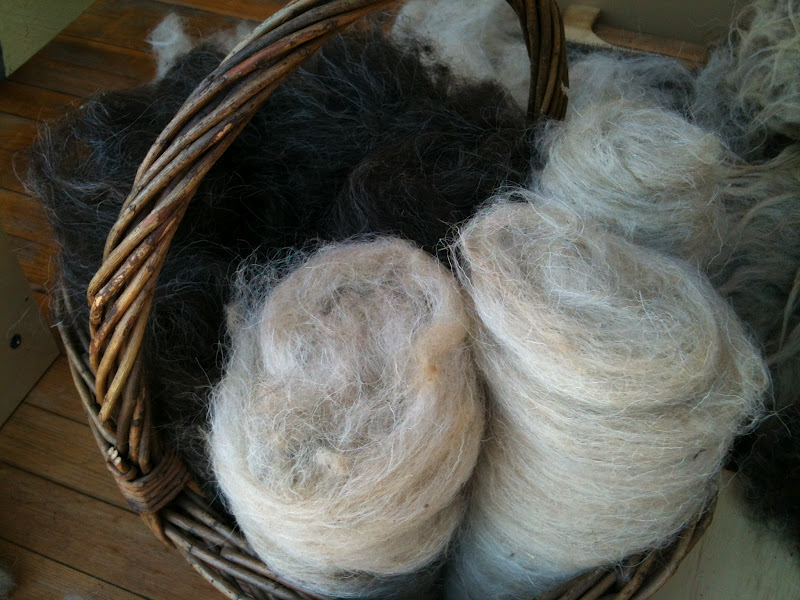
each fleece is a different color
I learned the Navajo-Churro is renowned for its hardiness and adaptability to extremes of climate. It's wool consists of a protective topcoat and soft undercoat. Some rams have four fully developed horns, a trait shared with few other breeds in the world. The Navajo-Churro is also popular due to its low-maintenance reputation, resistance to disease, and lean meat.  Although this breed is often raised for it's wool alone, the rancher we visited was raising his sheep solely for meat.
underside of fleece
This being my first time working with raw fleece I decided to do some research.  I emailed a local artist who makes the most amazing raw wool creations.  She graciously gave me some wonderful advice.  She said that learning in a hands-on way is definitely the best way.  But as a general suggestion, if you are just playing around with the wool, she recommends not using carding combs or other mechanical carders to prepare your wool.  By using your hands to open the locks of wool you will  develop a sensory and intuitive relationship with the fleece, a strong tactile connection.  Using carding combs is fine when you already know what you are doing and just need to process the wool faster, but it is important to learn the fiber.  So, practice taking small hand fulls of your fleece, opening them up and observing the fiber and how it behaves in your hands.  You can "hand-pick", as this is called, enough wool to make a flat sheet or a hat or a pouch, and then felt it by hand.  Because Navajo-Churro is low in lanolin, and as so much soap is used in the felting process, she doesn't wash her wool first.  


I love her advice!  So I immediately spent hours picking and teasing the wool with my hands.  After about a half a day of doing this, when I felt I understood how the fiber acts in my hands, I went in search of a carder.  Low and behold, a spectacular neighbor came over to lend me her drum carder.  And after getting acquainted with the machine we ended up with a nice basket of beautifully carded wool roving.  No washing, not too much fuss. 


I am so ecstatic about this wool!  The smell, the texture...I have plans for a wet felted bag and hat in the near future.  We may even have to trade our goats for few Navajo Churro sheep.  


Monday, July 2, 2012

Year Two: Putting Our Roots Down

"Gratitude necessitates blessing."


July 1st marks the second anniversary of Soul Flower Farm.  For two years now we have been stewards of this small piece of land on a hilly slope, nestled in the east bay area.  How our lives have changed as we have settled in and grown a deeper relationship to the soil, our animals, and each other, is difficult to describe in words.  


In the last year, while our days have been filled with the tasks of starting seeds, caring for chickens and goats, and tending the garden, we have also been watching with awe, our boys grow into men.  And when we look back at this second year here we can remember some extraordinary experiences; learning to build with cob, discovering a wonderful community, catching slippery kids as they dove their way -nose first- into the world, bringing home our first jersey cow and then breeding her.  There have still been countless cups of tea, back breaking work, blood, sweat, tears, swarms, and so much laughter.


With the invaluable experience of neighbors, trial and error, a fearless curiosity, and of course a bit of risk taking, our knowledge is increasing, as is our confidence.  Having the opportunity to tap into the rhythms of nature in our daily lives will never be a blessing we take for granted.  

getting dirty at sustainable building workshop
finished cob oven and bench
fresh goat's milk cheese
aerial view after community work party April 2012
2011 kitchen overflowing with harvest
natural beekeeping
first born set of kids
Oberhasli/Sable Saanen cross
feral chickens we adopted


We pray our adventures will continue.  And what is in the plan for year three?...aquaponics, a super adobe in-law unit,  more classes, community outreach, perhaps a CSA box, fresh raw cow's milk that can only come with a little calf, and a family vacation!


Top Photo by 
Lori Eanes


Sunday, June 24, 2012

Saving seed


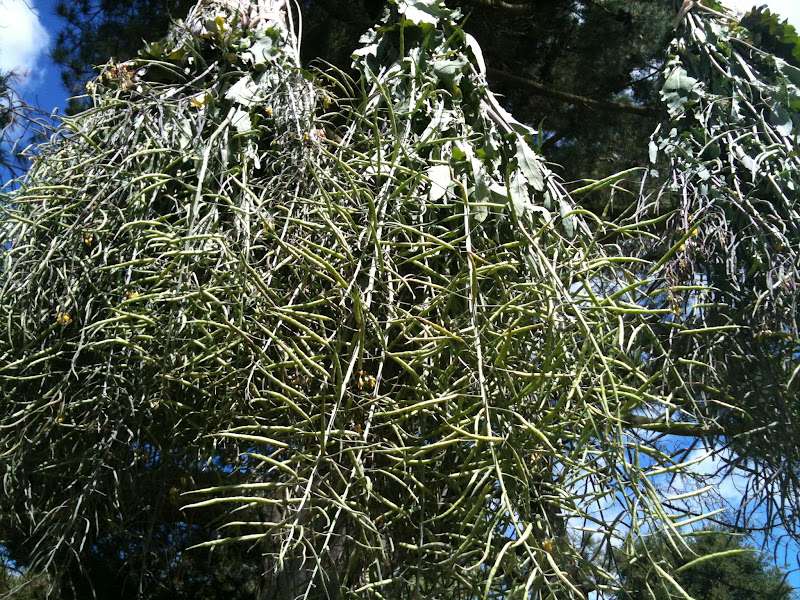
One of the main reasons we are farming is to try and establish some sort of food security for ourselves.  We want to acquire valuable skills so we can be beneficial members of a resilient community.  Saving our seeds is perhaps one of the most important actions we can take.  Since this is fairly new to us, we are still discovering the best ways to harvest and store the seeds from each species we grow.  This week I decided to cut down some of the plants I had been allowing to go to seed, in order to make room for new plants.  The pods are not quite ready but I am hoping that if I allow them to dry in the sun they will mature nicely.  There are way more Siberian kale seeds here than we can possibly use so I will bring a bunch back to our local seed library, which is a satisfying feeling since our original kale seeds came from there.

Siberian kale seed pods drying in the sun
I am very interested to know some systems others choose for storing their seeds. At first we stored our seeds in paper envelopes in a special drawer.  Eventually this got messy and seeds were scattered all over. We have now opted for glass jars covered in paper and labeled, which we store in a dark cabinet.  This has been efficient but the glass is problematic (living in earthquake country). 


Our first season starting all of our plants from seed, almost everything we planted came from free seeds; either from our local seed library, a nearby ecology center, or traded from friends.  I also found out about the Germplasm Resources Information Network (GRIN).  It is listed as a source for rare seeds in the back of Perennial Vegetables.  GRIN is a national collection of plant materials of hundreds of crops and thousands of wild crop relatives from all over the globe.  Free seeds and plants are available for research purposes.  What intrigued me about GRIN is that I could order seeds collected by hand in the forests of the Ukraine, some rare variety of quinoa from Peru, or a stash of corn seed that has been saved by some farmer's wife in Nebraska for decades.  The downside to GRIN is that you have no way to know if the seeds are organic so I tried to stick with the wild species that interested me.  To be honest, I have not planted many of the seeds I received from this source but the ones I have planted I am quite happy with, like the tree spinach (aka lambs quarters).  


It has been fun experimenting with mystery varieties but this year we opted to purchase specific heirloom varieties (from here) that we had read about and were excited to try; for flavor, size, appearance, and which are the best keepers.  Learning about the varieties that grow well in our micro-climate is taking our gardening to another level and teaching us yet another invaluable aspect of sustainability.  


Thursday, June 21, 2012

Infinite Uses of the Pallet


It seems to be all about pallets around here.  Why?  They are free, super strong, and weather resistant, plus they're everywhere.  And for us, it just makes sense to use what we have or what is easily accessible.  

The pallet chicken coop is coming along.  After a bit of a break to work on many other projects, we are returning to finish it up.  We still need to insulate with straw, seal up the walls and paint the exterior.  The chickens don't seem to care about the disarray, they have happily taken up in the shade and even started laying in the empty boxes.


Another recent project is our pallet stanchion with eucalyptus branches that function as the closure.  Ginger doesn't seem to put up a fight.

Our mini green house is made of pallet wood and recycled windows, while the seed flats are just shortened, re-assembled pallet boards.


As for the Warre hives, the top box which is the insulation layer is made from pallet wood while the rest is pine.  


The options for working with this abundant  and durable resource are seemingly endless once you put your imagination to it. Isn't that just about true of anything though? 


Top Photos 
by Lori Eanes

Sunday, June 17, 2012

Father's Day Garden Mosaics


Yesterday, my Mom and I had a great time crafting and making some wonderful mosaic garden stepping stones.  This is a fast and easy project that appeals to my desire for instant gratification.  There are basically only four steps; mix the cement/concrete with water to the consistancy of a thick brownie mix, pour into a mold and smooth, design your mosaic, and allow to dry for about 48 hours. We used broken glass pieces, glass gems, and small mirrors as our medium but you can also use tiles, shells, beads, whatever is pleasing to your aesthetic.  After Father's Day breakfast this morning we presented our garden stones to Dad who was very pleased and excited at the prospect of doing a bigger mosaic project.  We are thinking bird bath, fountain, maybe even a garden wall.  


Hope you are enjoying this beautiful weather and happy Father's Day to all you Dad's out there!